Why Institutional Horror Fiction Hits Hard
A monster in the woods can be outrun. A monster with a badge, a budget, three forms to sign, and a cheerful woman at the front desk is another kind of problem. Institutional horror fiction understands that the scariest place is often the place built to keep you safe – or at least process your complaint before lunch.
This is horror with fluorescent lighting. The threat may live in a prison, hospital, school district, military base, courthouse, biotech company, city agency, church, or private security outfit with a logo that looks expensive. Nobody has to cackle. Nobody even has to know they are evil. They just have to follow policy while something terrible happens to the person in the waiting room.
What Makes Institutional Horror Fiction Different?
Ordinary horror often begins with a violation. Somebody opens the wrong door, takes the wrong road, reads the dead man’s diary, or buys a house for suspiciously low money. Institutional horror begins after the victim does the sensible thing. They call for help. They report the problem. They show up for treatment. They cooperate.
That is the dirty trick.
The institution has authority, paperwork, locked doors, and people who can explain why you cannot leave yet. It can call your fear a symptom. It can lose the file. It can move the prisoner, quarantine the witness, classify the evidence, deny the claim, and hold a press conference about its commitment to transparency. The machine does not need to be supernatural to feel inhuman.
A haunted house has one bad address. An institution can spread across a county, a state, or a whole damned country. That scale gives the story teeth. The protagonist is not just fighting a killer. They are fighting an organization that can make the killer disappear into a database.
The Real Monster Is Usually Procedure
The best institutional horror fiction does not treat every clerk, nurse, guard, teacher, or cop as a villain. That gets cartoonish fast. Most people inside the system are trying to get through a shift, protect a pension, avoid trouble, or keep their own heads down. Some are decent. A few may even try to help.
But decent people can still feed a terrible machine.
A prison guard follows an order because he has a mortgage. A hospital administrator buries an alarming result because the board will panic. A county inspector signs off on a building because his boss wants the ribbon-cutting on Friday. The person at the center of the nightmare may be a true believer, a coward, a sadist, or an exhausted bureaucrat who says, “That’s above my pay grade,” while the elevator doors close on somebody screaming.
That is where the dread comes from. Evil with a personal motive can be confronted. Evil with a chain of command is harder to kill.
Why the Rules Make It Worse
Rules create a particular kind of trap. They tell characters what they cannot do, when they cannot leave, who they cannot contact, and why every obvious escape route somehow violates protocol. A locked basement is scary. A locked basement designated as a secure clinical area is scarier because somebody has a laminated reason for the lock.
The rules also let writers put pressure on decent characters. A detective may know the medical examiner is lying but need a warrant. A public defender may believe her client is being experimented on but lack standing. A nurse may see the pattern but risk losing her license if she talks. Every step toward the truth carries a price.
Good horror loves a closed door. Institutional horror gives the door a keypad, a camera, and a legal department.
Settings That Carry Their Own Bad News
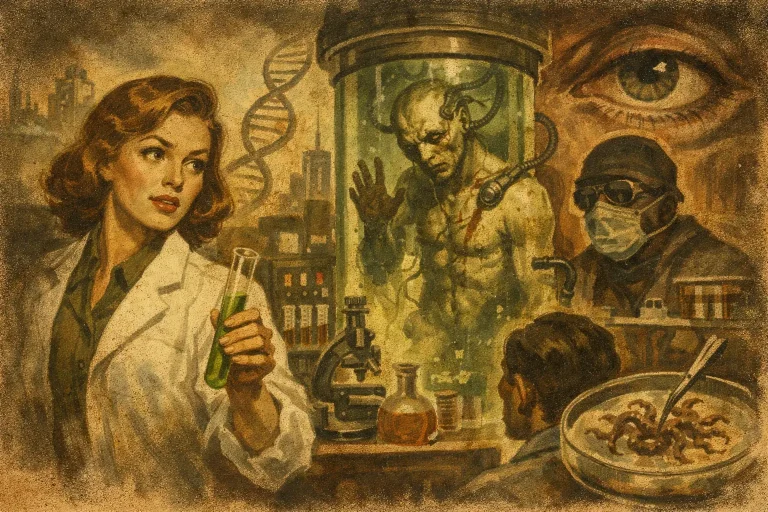
Hospitals and prisons are natural homes for the form because they control bodies. One is supposed to heal you. The other is supposed to contain you. Both have rooms you do not enter without permission, staff who speak in codes, and enough institutional language to turn a simple question into fog.
But the genre gets more interesting when it wanders outside the usual corridors. Consider a zoning board that approves a development built over contaminated ground. A school that begins screening children for a condition nobody can define. A veterans’ program that offers a treatment with a classified side effect. A redevelopment authority that clears a neighborhood because the people there have become inconvenient to somebody’s project.
The setting should not be merely a backdrop. It should create the danger. A corrupt police department is familiar territory. A police department that has accidentally built its entire evidence system around a creature, contagion, or ritual it cannot admit exists? Now the desk sergeant has a real problem.
Institutional Horror Fiction Works Best When It Stays Human
There is a temptation to explain everything with a grand conspiracy. Sometimes that works. A cabal in a basement planning to weaponize a fungus has a certain charm. But the more frightening version often has messier motives: budget cuts, careerism, political pressure, medical vanity, profit, panic, and the old American tradition of treating poor people as disposable when the quarterly numbers look rough.
A conspiracy is neat. Real institutions are not.
Let the cover-up have contradictions. Let departments compete. Let one official be horrified but powerless, another be cynical but useful, and a third be too busy protecting a promotion to notice the bodies piling up. The machine should grind, stall, lie, and occasionally send an email marked “urgent” at 4:57 on a Friday.
Humor belongs here too. Not because suffering is funny, but because institutions are often absurd precisely when they are most dangerous. A man can be chased through a condemned public-health facility by something wearing the face of his dead brother, then get stopped by a security guard demanding to see his visitor badge. That is horror. That is comedy. That is also probably how the guard keeps his job.
How to Build the Pressure
The strongest stories make the protagonist dependent on the very system threatening them. Maybe they need medicine, parole, custody of a child, a government contract, a clean criminal record, or the truth about a missing relative. Walking away is not an option. Calling the police only delivers them back to the people running the nightmare.
Start with a small wrongness. A file has been altered. A patient insists that someone else has been sleeping in her room. An inmate disappears, but every official record says he was never there. Then let each attempt to get help make the situation worse.
The escalation should feel logical, even when the thing behind it is not. If a biotech firm is growing something it cannot control, its lawyers will not begin with machine guns. They will begin with nondisclosure agreements, friendly pressure, and a doctor explaining that stress can distort memory. The guns come later, after the meeting notes disappear.
This is also where dialogue earns its keep. Institutional horror needs people talking around the truth. The best lines are polite, evasive, and loaded like a revolver in a desk drawer.
“Mr. Bell, nobody is denying you saw something.”
“That’s generous.”
“We’re saying the thing you saw may not have been there.”
The Pulp Version Has Dirt Under Its Nails
Prestige horror sometimes treats institutions as chilly metaphors. Fine. There is room for that. But pulp-minded institutional horror should smell like burnt coffee, bleach, gun oil, old carpet, and whatever is leaking from the evidence locker.
Give the place a local pulse. A county jail in West Texas should not sound like a research hospital outside Boston. A Florida condo board can generate a different flavor of terror than a Midwestern meatpacking plant. Regional details keep the story from becoming a lecture about systems. Somebody is always trying to make a deal, hide a body, save face, or get home before the storm hits.
That is the useful thing about institutional horror fiction: it gives writers a big ugly machine, then lets them jam a desperate human being into the gears. The monster may have tentacles. It may have a pension plan. Either way, it will ask you to take a number and wait to be called.